The Story of Mid-Autumn Festival and the Mooncake — China's Most Romantic Festival and Its Legendary Past
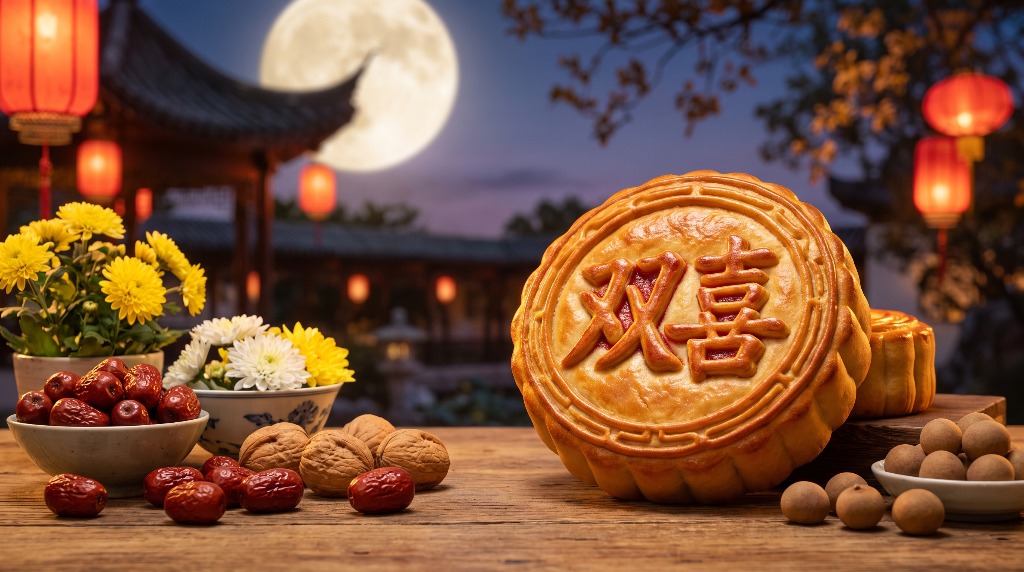
Every autumn, when the moon reaches its fullest and brightest, over a billion people across China pause to gaze upward and share a ritual stretching back three thousand years. This is the Mid-Autumn Festival — built around the full moon, family reunion, and a beloved pastry that once carried secret messages of rebellion. This is the story of a goddess, a revolution, and the world's most enduring food festival.
The Festival That Began with a Bow
The roots of the Mid-Autumn Festival reach deep into ancient Chinese civilization. As early as the Zhou dynasty (1046–256 BCE), Chinese rulers practiced the ritual of 祭月 — offering sacrifices to the moon. The ancient text Zhou Li records that "the Son of Heaven in spring offered sacrifices to the sun, and in autumn to the moon." This royal devotion to the autumn moon gradually filtered down through the aristocracy and eventually took root among ordinary people.
By the Tang dynasty (618–907 CE), the practice of moon-watching had become a formalized festival. The Book of Tang records "the Mid-Autumn Festival on the fifteenth day of the eighth month." The full moon of the eighth lunar month had become a cultural landmark — a moment when the harvest was gathered, the air was cool, and the night sky offered the year's most spectacular moon.
The festival as it is celebrated today took its recognizable shape during the Song dynasty (960–1279 CE), when records show the full Mid-Autumn customs: families gathered to admire the moon, offer sacrifices, and feast together under its light. From that era forward, the Mid-Autumn Festival became one of the four great festivals of the Chinese calendar, second only to the Spring Festival in its cultural importance.
Chang'e: The Lady Who Flew to the Moon
No story is more central to the Mid-Autumn Festival than that of Chang'e (嫦娥), the Moon Goddess. The tale appears in some of China's oldest texts — Guizang (归藏, Warring States period) and Huainanzi (淮南子, compiled 179–122 BCE) — making it one of the most ancient narratives in Chinese culture.
The basic story is this: In ancient times, ten suns orbited the earth, their fierce heat scorching the land and driving the people to desperation. A heroic archer named Houyi (后羿) descended to earth, steadied his bow, and shot down nine of the ten suns, saving humanity from destruction. For his great deed, the Queen Mother of the West (西王母) rewarded him with a potion of immortality.
Houyi entrusted the potion to his wife, Chang'e, for safekeeping. But one day, while Houyi was away, a villain broke into their home and demanded the potion. With no other way to protect it, Chang'e drank the entire flask herself. At once, she felt herself becoming weightless. Her feet left the ground. She floated higher and higher — past the clouds, past the mountains, past all earthly things — until she came to rest on the moon itself.
There, in the cold silence of the lunar palace, she has lived ever since. The ancient texts say she became the Moon Goddess, and on the night of the full moon — especially the fifteenth night of the eighth lunar month — her presence is at its most powerful.

Chang'e is not alone on the moon. The Tang dynasty poet Li Shangyin imagined her loneliness in a famous couplet: "Chang'e ought to be regretting her stolen elixir; every night, under the blue sea and green sky, her heart aches." To keep her company, Chinese mythology added two companions: Wu Gang (吴刚), condemned to chop an eternal cassia tree that heals itself the moment it is cut; and the** Jade Rabbit (玉兔)**, who pounds the elixir of immortality in a mortar — an image so beloved that even today, children are given rabbit-shaped lanterns to carry during Mid-Autumn celebrations.
The Mooncake: From Imperial Offering to Revolutionary Tool
The mooncake — 月饼 (yuèbǐng) — is inseparable from the Mid-Autumn Festival, yet its history is layered, complex, and richer than most people realize.
The earliest "mooncakes" were not called mooncakes at all. During the Han dynasty, round flat cakes were offered to the Moon Goddess as ritual tribute, then shared among family members — a practice of 祭月 that echoes to this day. The Book of Han records that by the Western Han period (206 BCE – 9 CE), round cakes were already part of autumn moon-watching rituals.
By the Tang dynasty, a popular sweet pastry called 胡饼 (húbǐng) — "barbarian cake," filled with honey and sesame and brought along the Silk Road — had become the forerunner of the modern mooncake. According to one well-circulated story, during the reign of Emperor Xuanzong, General Li Jing returned from a campaign against the Göktürks bearing these foreign cakes as tribute. The emperor and his consort Yang Guifei admired the round cakes under the autumn moon; Yang Guifei reportedly suggested renaming them 月饼 (yuèbǐng) — "moon cakes" — a name that has endured ever since.
But the most historically grounded story of the mooncake's connection to the Mid-Autumn Festival begins in the Yuan dynasty (1271–1368), in the brutal twilight of Mongol rule in China.

At the end of the Yuan dynasty, Chinese peasants suffered under increasingly brutal Mongol rule. A resistance movement began to coalesce around a leader named Zhu Yuanzhang — who would one day become the founding emperor of the Ming dynasty. But communicating between rebel groups was nearly impossible; Yuan soldiers searched every courier and inspected every package.
Zhu Yuanzhang's strategist, the legendary Liu Bowen (刘伯温), devised an audacious plan. He instructed rebel sympathizers to bake secret messages into round cakes. The messages read simply: "On the night of the fifteenth of the eighth month, rise in rebellion." These cakes were distributed across the country in the days leading up to Mid-Autumn Festival, a time when the giving of cakes between families and friends was already customary and drew no suspicion.
On the appointed night — the very night of the Mid-Autumn Festival — rebel forces across China rose up simultaneously. Within months, Zhu Yuanzhang had conquered the Yuan capital, and the Mongol dynasty fell. The rebel who had carried secret messages inside round cakes had become the Hongwu Emperor.
According to historical accounts, Zhu Yuanzhang ordered that the round cakes that had carried his revolution's secrets be served at the Mid-Autumn Festival celebration. Thus the mooncake — which had served as a tool of liberation — was formally incorporated into the festival as its defining food. The Ming dynasty West Lake Travel Notes (西湖游览志会) records: "On the fifteenth of the eighth month, called Mid-Autumn, the people give mooncakes to each other, seeking reunion."
What the Mooncake Carries Today
For international readers who encounter the Mid-Autumn Festival for the first time, the customs may seem familiar — families gathering, sweets shared, lanterns lit — and yet the emotional weight they carry is distinctly Chinese. The round shape of the mooncake is not decorative; it is a statement. In Chinese, 团圆 (tuányuán) — "reunion" — is the festival's deepest meaning, and the circle of the mooncake is a visible echo of the full moon, which in turn represents the family gathered whole.
The great Song dynasty poet Su Dongpo captured this in a simple line: "Small cakes, one bites and tastes the moon, within them is butter and sweet syrup." The mooncake is not merely food; it is a metaphor for completeness, for the family that has come back together, for the year that has arrived at its moment of plenty.
In the centuries since the Yuan dynasty, mooncakes have evolved into dozens of regional varieties. The Guangdong (Cantonese) style — with its thin, soft crust and rich lotus seed paste — dominates global exports. The Suzhou style is flaky and delicate. The Beijing style features dense, rustic dough. And in Chaoshan (潮汕), the old mooncakes are closer to the ancient originals — smaller, harder, and savory rather than sweet. Each region has made the mooncake its own.
A Festival That Crosses Borders
The Mid-Autumn Festival is not only China's. In South Korea, where it is called Chuseok (추석), families gather for a harvest festival, prepare special rice cakes called songpyeon, and visit ancestral graves. In Japan, the autumn full moon is celebrated as Tsukimi (月見), with round rice dumplings (dango) set out as offerings. In Vietnam, the festival is Tết Trung Thu, marked by children's lanterns and special bánh dẻo cakes.
These parallel celebrations across East Asia are not coincidence — they reflect the deep historical interweaving of Chinese-influenced civilizations and the universal human experience of looking up at the same full moon and feeling the pull of home.

The Moon Always Rises
In 2007, China launched its lunar exploration program and named it Project Chang'e — a tribute to the goddess who never stopped watching over the earth from her lunar palace. In 2019, the Chang'e 4 spacecraft landed on the far side of the moon — the first human craft to do so.
Perhaps it is this that makes the Mid-Autumn Festival so enduring: it sits at the intersection of myth and science, family and nation, ancient ritual and modern celebration. Every year, on the fifteenth night of the eighth lunar month, families across China and the diaspora look up at the same moon, eat the same round cake, and tell the same stories. And whether the mooncake began as an imperial tribute, a Silk Road import, or a revolutionary tool, today it means only one thing: you are home.
Comments 0
You'll be asked to choose between anonymous and signed-in posting.